Karate
Karate
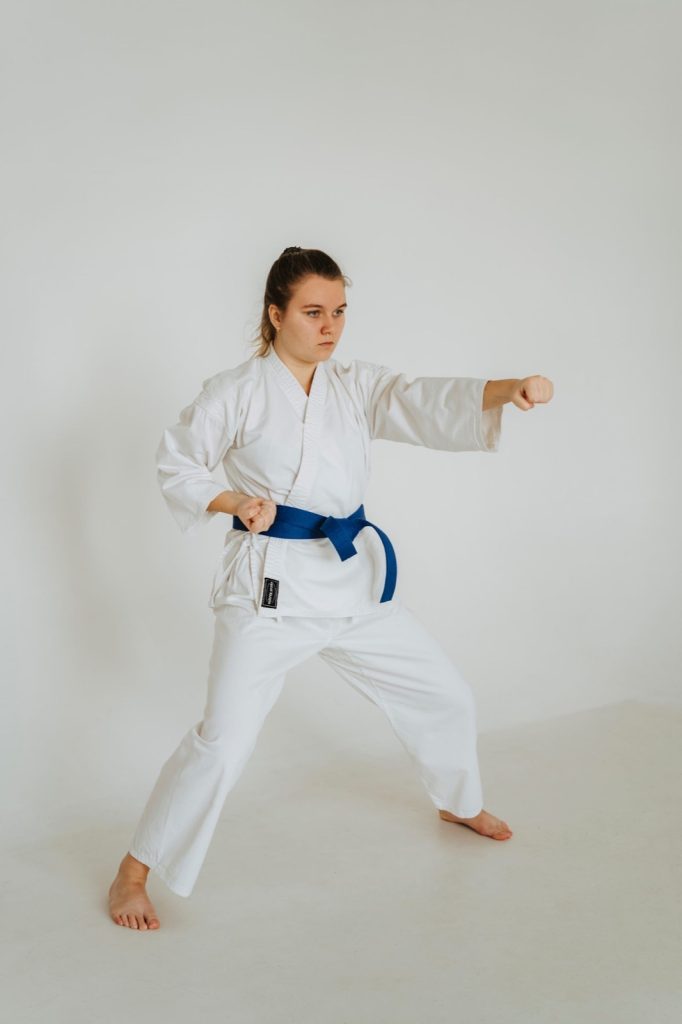
Image: olia danilevich / Pexels · Pexels License
Overview
An Okinawan art understood through three linked practices.
Karate developed through Ryukyuan, Chinese, Okinawan, and mainland Japanese contexts. Modern dōjō connect fundamental movement, formal sequences, and partner work in different proportions.
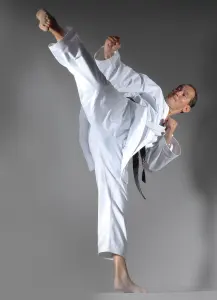
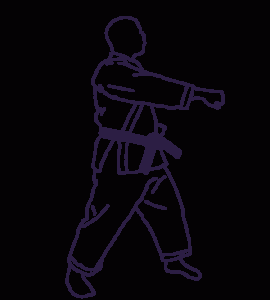
Stances, footwork, strikes, kicks, and defensive movements.
Sequences preserve rhythm, direction, breathing, and technical relationships.
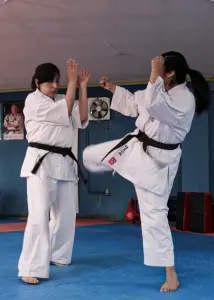
Partner practice develops timing, control, adaptation, and awareness.
- Japanese
- 空手
“Empty hand” - Origin
- Ryukyu Kingdom
Okinawa - Type
- Striking martial art
- Historical exchange
- Okinawan te and Chinese martial traditions
- Practice triad
- Kihon, kata, and kumite
- Modern forms
- Education, self-defence, cultural practice, and sport
01Historical development
From a maritime kingdom to a global family of practices.
The sequence is institutional as well as technical: private transmission, school education, mainland networks, organisations, and competition each changed how Karate was taught and named.
- Ryukyu Kingdom
Exchange across seas
Local methods known as te developed in a kingdom connected with China, Japan, and Southeast Asia. The familiar story of unarmed farmers creating Karate solely to fight armed samurai is too simple.
- 19th century
- Early 1900s
Public education
Ankō Itosu helped introduce Karate into Okinawan schools and reorganised material for group teaching. The Pinan kata offered a progressive route for beginners.
- From 1922
Mainland networks
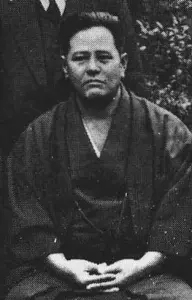
Gichin Funakoshi demonstrated Karate in Tokyo and taught in universities and new dōjō. Contact with Jigoro Kano and modern budō institutions influenced presentation, clothing, and grading.
For the broader island history, begin with Okinawan Karate.
02Practice structure
The triad is a relationship—not a universal lesson order.
Schools differ in emphasis and method. A useful reading is that fundamentals supply vocabulary, kata organises it, and partner work tests distance and decisions.
Kihon
Alignment, stance, movement, striking surfaces, defensive actions, and controlled repetition.
Kata
Set sequences whose application, rhythm, and interpretation depend on school and teacher.
Kumite
Partner exercises or sparring, ranging from arranged drills to rule-governed free exchange.
Use Karate Techniques for the principal movement families. Competition is a context with its own rules—not the definition of every dōjō’s practice.
03Okinawan pathways
Three regional lenses, with overlapping transmission.
The cards indicate historical orientation. They do not draw hard borders around every teacher, kata, or later organisation.
Overlap, study, and later reorganisation are more accurate than three isolated paths.
04Selected modern schools
A family tree needs more than one kind of connector.
These major schools grew through documented teachers, mixed study, institutional reorganisation, and later competition cultures—not one perfectly linear descent.
Shotokan
Gichin Funakoshi · mainland teaching and university networks.
Gōjū-ryū
Chōjun Miyagi · hard–soft framing, breathing, kata, and partner work.
Shitō-ryū
Kenwa Mabuni · a wide kata inheritance from multiple teachers.
Wadō-ryū
Hironori Ōtsuka · Karate practice reorganised through a jujutsu-informed lens.
Kyokushin
Masutatsu Ōyama · a postwar organisation known for full-contact competition.
See the Japanese Martial Arts Lineage Map for a selective diagram that distinguishes transmission from influence and institutional borrowing.
05Conduct & competition
Restraint, expression, and rules answer different questions.
Karate can be an ethical practice, a cultural inheritance, a self-defence study, physical education, and a sport. One setting should not silently stand for all the others.
“There is no first attack in Karate.”
Karate ni sente nashi expresses an ideal of restraint. Dōjō kun vary, but commonly connect sincerity, effort, courtesy, self-control, and the responsible use of skill. See Dōjō Etiquette.
Kata and kumite competition
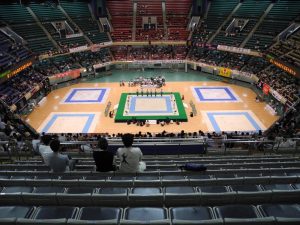
Kata performance and kumite scoring use explicit criteria and current rulesets. Karate at the Asian Games provides one edition-specific institutional example.
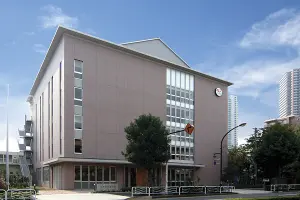
Place matters: Okinawa remains Karate’s cultural heartland. The Okinawa Karate Kaikan supports exhibitions, research, exchange, and training; visitors should confirm current dōjō rules before attending.
06Verification method
Attach five labels before calling something “Karate”.
This prevents an Okinawan historical practice, one school’s teaching method, and a current competition rule from becoming one timeless universal claim.
- 1Place and period
Ryukyu Kingdom, prewar Okinawa, mainland Japan, postwar organisation, or present-day event?
- 2School, teacher, or organisation
Name the actual line or institution whenever the evidence allows it.
- 3Practice setting
Kihon, kata, bunkai, partner drill, kumite, self-defence, education, or sport?
- 4Ruleset
State which organisation and edition governs a competition claim.
- 5Terminology source
Check an official or scholarly source rather than treating one English gloss as universal.
Useful starting points: the Japan Karate Federation terminology guide and Nippon Budokan history and practice guide.
07Terminology
Nine terms for reading a dōjō description accurately.
- Karateka
- A person who practises Karate.
- Karategi
- The white training uniform.
- Dōjō
- A place for practising a martial way.
- Sensei
- A teacher; literally, one who has gone before.
- Kihon
- Fundamental techniques and movement.
- Kata
- A formal sequence preserving technical relationships.
- Kumite
- Partner practice or sparring.
- Rei
- Respect and courtesy, often expressed through a bow.
- Zanshin
- Continuing awareness before, during, and after an action.
Sources and further reading
Last updated: